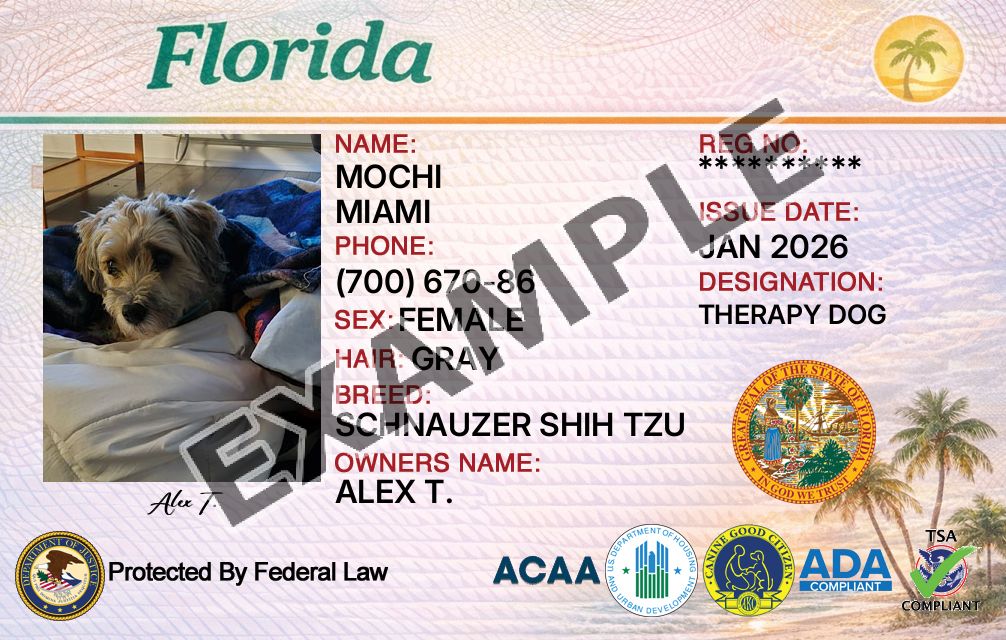
If you’re searching where do I register my dog in Taylor County, Florida for my service dog or emotional support dog, the key thing to know is this: dog “registration” usually means a local dog license and rabies tag, while service dog and emotional support animal (ESA) status are handled under different laws and do not come from a county “service dog registry.”
In Taylor County, dog licensing and rabies enforcement are typically handled locally through county animal control/animal services and supported by the Florida Department of Health in Taylor County for rabies surveillance and bite investigations. This page explains where to register a dog in Taylor County, Florida, what paperwork you’ll likely need, and how licensing differs from service dog and ESA rules.
Where to Register or License Your Dog in Taylor County, Florida
Because licensing is handled locally, start with Taylor County’s animal control/animal services office for the most direct guidance on an animal control dog license Taylor County Florida process, replacement tags, and enforcement questions. For rabies-related public health questions (like bite reporting and rabies surveillance), the county health department is also a key official resource.
Taylor County Animal Control
| Address | 302 W. Maurice Linton Rd. |
|---|---|
| City/State/ZIP | Perry, FL 32347 |
| Phone | (850) 838-3525 |
| Not publicly listed | |
| Office Hours | Monday–Friday: 10:00 a.m.–5:00 p.m. (verify before visiting) |
Use this office for local licensing/tag questions, animal control ordinances, and county guidance on how to obtain or replace a county tag.
Florida Department of Health in Taylor County
| Address | 1215 North Peacock Ave. |
|---|---|
| City/State/ZIP | Perry, FL 32347 |
| Phone | (850) 584-5087 |
| CHD62Web.zzzzFeedback@flhealth.gov | |
| Office Hours | Monday–Friday: 8:00 a.m.–5:00 p.m. |
Use this office for rabies surveillance/public health guidance, including questions after a bite exposure or rabies-related public health information.
Taylor County Board of County Commissioners (General County Office)
| Address | 201 E Green St |
|---|---|
| City/State/ZIP | Perry, FL 32347 |
| Phone | Not listed here |
| Not listed here | |
| Office Hours | Not listed here |
If you’re unsure which department handles licensing details, this office can help direct you to the correct county department (often Animal Control/Animal Services).
Overview of Dog Licensing in Taylor County, Florida
What “registering your dog” usually means
In most Florida counties, when people say “register my dog,” they mean obtaining a local license/tag that is tied to rabies vaccination. This is why you’ll often hear “rabies tag,” “county tag,” or “dog license” used interchangeably. In practice, where to register a dog in Taylor County, Florida often means starting with the county’s animal control/animal services office and/or the veterinarian who issues rabies vaccinations and documentation.
Why licensing is local (county/city) instead of statewide
Florida does not operate a single statewide dog licensing office for every community. Instead, dog licensing rules—such as who must be licensed, the age at which licensing begins, and what tags are accepted—are commonly set and enforced at the county or city level. That’s why the right answer to “where do I register my dog in Taylor County, Florida” is usually a local Taylor County office, not a federal agency or a third-party registry.
Rabies vaccination is the cornerstone
Whether your dog is a pet, a trained service dog, or an ESA, the rabies vaccination requirement still applies. Local licensing typically requires proof of a current rabies vaccination administered by (or under the supervision of) a veterinarian, and the tag duration typically follows the vaccine’s duration of immunity.
How Dog Licensing Works Locally in Taylor County, Florida
Step-by-step: getting a local license/tag
- Get your dog vaccinated for rabies by a licensed veterinarian (or under veterinary supervision) and obtain a rabies certificate/proof.
- Contact Taylor County Animal Control to confirm the current licensing process, fees, and acceptable proof for a dog license in Taylor County, Florida. Some counties issue tags directly; others authorize veterinarians to issue tags or accept license applications.
- Submit required information (commonly owner identification and address/residency details) and pay any required licensing fee.
- Attach the tag to your dog’s collar and keep backup documentation (paper or digital photo) of rabies proof and license/tag details.
What to expect if your dog is a service dog or ESA
A common misconception is that a service dog or ESA is “registered” through a special service-animal county program. Typically, your dog still follows the same public health rules—especially rabies vaccination—and may still need the same local tag requirements as any other dog. In other words, service dog status and ESA status generally do not replace the local animal control dog license Taylor County Florida process.
Rabies enforcement, bites, and public health
If there is a bite incident or rabies exposure concern, the process often involves both animal control (for animal-related investigation/enforcement) and the Florida Department of Health in Taylor County (for public health guidance and rabies surveillance). If your pet is bitten or bites someone, contact the appropriate local office promptly for instructions and required reporting steps.
Service Dog Laws in Taylor County, Florida
What legally makes a dog a service dog
A service dog is generally a dog that is individually trained to do work or perform tasks for a person with a disability. Comfort, companionship, or emotional support by itself does not meet the service-dog task requirement under service-animal definitions used for public access.
No “official service dog registration” required for public access
For public places (like stores and restaurants), service dog access is governed by disability access rules rather than a county licensing program. Businesses generally cannot require a special service dog ID card, a “certificate,” or proof of registration as a condition of entry.
The two questions a business may ask (when it’s not obvious)
If it’s not obvious that your dog is a service animal, staff may generally ask only:
- Whether the dog is a service animal required because of a disability, and
- What work or task the dog has been trained to perform.
How service dog laws interact with local licensing
Even though you don’t “register” a service dog for public access, your dog may still need to comply with local health and animal control rules—especially rabies vaccination and any county tag requirements. So if your goal is both (1) legal public access as a service dog and (2) meeting local rules, you may need both a locally issued dog license in Taylor County, Florida (if required) and a properly trained service dog.
Emotional Support Animal Rules in Taylor County, Florida
What an emotional support animal (ESA) is (and is not)
An emotional support animal provides comfort that can help with symptoms of a disability, but an ESA is not the same as a service dog for public access. ESAs generally do not have the same right to enter places that only allow service animals (such as many indoor public accommodations).
Where ESAs are most commonly recognized: housing
ESA requests most often come up in housing situations as a reasonable accommodation request. Housing rules are separate from: public access rules (stores/restaurants) and separate from local dog licensing. That means getting help for housing doesn’t usually involve an “ESA registration office” in Taylor County, but it may involve providing documentation to a housing provider as part of an accommodation process.
Licensing still applies to ESAs
Even if your dog is an ESA, local public health and animal control requirements can still apply—especially rabies vaccination and any county-issued tags. If your question is specifically where to register a dog in Taylor County, Florida for an ESA, start with Taylor County Animal Control for licensing/tag requirements and keep your rabies documentation current.